A Phone Without Internet for Kids: Every Real Option, Compared
Flip phones, Gabb, Bark, the Light Phone, GPS watches: every real way to give your child calls, texts, and GPS without the open internet, compared honestly.
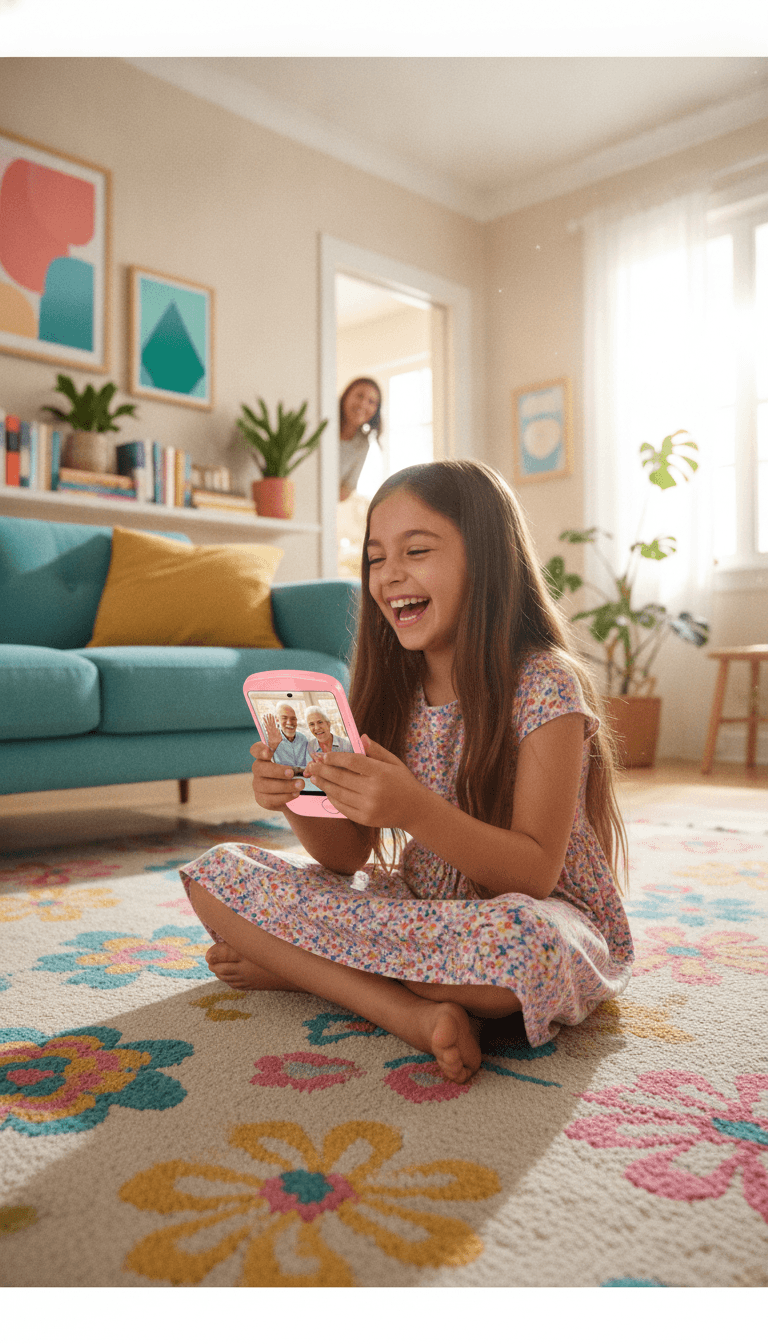
If you searched for a “phone without internet for kids,” you already know exactly what you want: a way to call and text your child, and know where they are, without handing them the entire internet. Here is the direct answer up front: yes, that category of device genuinely exists, it is growing fast, and you have four real options. For most families the best fit is a GPS smartwatch for roughly ages 5-9, a purpose-built safe phone (calls, texts, GPS, and a camera, with no browser, no social media, and no app store) for roughly ages 8-12, a basic flip phone for older kids who only need the basics, or an adult minimalist phone for teens choosing intentionally simple tech for themselves.
We make one of those devices, the MeWatch FirstPhone, so we have a horse in this race. That is exactly why this guide names our competitors, quotes their real prices, credits what they do well, and lists our own limitations in plain language. Every competitor price and spec below was checked against the brand’s own published pages as of August 2026; prices change, so always confirm on the brand’s site before you buy.
A phone without internet is a parenting strategy, not a compromise
Let’s clear something up first: choosing a no-internet phone is not “depriving” your child or falling behind. It has become one of the fastest-growing, most openly organized parenting movements in the world, and knowing that matters, because the hardest part of delaying the smartphone is feeling like the only family doing it.
In the United States, Wait Until 8th (a movement founded in 2017 by parents in Austin, Texas) asks families to pledge not to give their child a smartphone until at least the end of 8th grade. The clever part is the mechanism: the pledge only activates once at least ten families from the same grade at the same school have signed, so no child is ever the only one waiting. As of August 2026, the organization reports that more than 155,000 parents have signed. Notably, the pledge explicitly allows a basic phone that just calls and texts. The movement’s target is the open internet and social feeds, not the phone call.
Across the Atlantic, Smartphone Free Childhood (a UK grassroots movement founded in early 2024 by two mothers, Daisy Greenwell and Clare Fernyhough) organizes parents through a “Parent Pact”: a public commitment to delay smartphones until roughly age 14 and social media until 16. As of August 2026 it reports over 140,000 parents across more than 13,500 schools, with sister groups in dozens of countries. Again, the same principle: when families decide together, the playground pressure that makes parents cave simply dissolves.
Neither movement is anti-technology. Both draw the same line we drew when designing our own devices: kids need connection years before they need the internet. The question is not whether your child should be reachable; it is which device gives them calls, texts, and safety without the feeds, the strangers, and the app store. That is what the rest of this guide compares.
The spectrum of no-internet options at a glance
“No internet” covers a surprisingly wide range of devices, from a $49 wrist-worn watch to a $799 designer minimalist phone. They differ most in three places: who your child can talk to (anyone vs. an approved list), whether you get GPS tracking, and how truly internet-free the device is. That last one trips up more parents than any other, because many ordinary flip phones quietly include a basic web browser. All prices are from each brand’s published pages as of August 2026.
| Option | Typical cost (Aug 2026) | Calls & texts | Parent GPS tracking | Camera | Internet & apps |
|---|---|---|---|---|---|
| Basic flip phone | Varies by carrier; usually the cheapest upfront | Yes, to and from anyone | No parent app on most models | Usually basic | Many models include a basic browser, so check before buying |
| Gabb Phone 4 | $149.99 device + plans $24.99-$39.99/mo | Yes | Yes, MyGabb app with safe zones | Front + rear | No browser or social media; 16 preloaded apps + a curated library |
| Bark Phone | $10/mo device (24 mo) + plans from $29/mo | Yes, with parent monitoring | Yes | Yes | Parent-controlled; the starter tier has no internet, app store, or games, and more can be enabled later |
| Light Phone III | $799 retail at launch (adult-oriented) | Yes, to and from anyone | No parent tracking app | Yes (50 MP rear) | No browser or social media, by design |
| MeWatch GPS smartwatches | $49-$129 | Approved contacts only | Yes: GPS + safe zones + SOS | On some models | None: no browser, social, or app store |
| MeWatch FirstPhone | $69 | Approved contacts only | Yes: GPS + SOS button | Yes | None: no browser, social, or app store |
Option 1: the basic flip phone
The classic answer, and still a reasonable one for the right child. A flip phone from any carrier gives your child calls and texts on a device sturdy enough to survive a backpack, usually for the lowest upfront cost of anything on this list.
What it does well
Simplicity and price. There is no feed to scroll, the battery lasts for days, and if it gets lost at soccer practice the replacement cost will not ruin your week. For a responsible older kid or young teen who genuinely just needs to say “practice ran late, pick me up at six,” a flip phone can be all the phone they need.
Where it falls short for younger kids
- Anyone can call or text your child. There is no approved-contacts list, which means spam, scams, and strangers reach the same inbox you do.
- No parent app, and usually no GPS tracking. You cannot see where your child is or set safe-zone alerts.
- Many flip phones are not actually internet-free. A surprising number of “dumb phones” ship with a basic web browser tucked in a menu. It is clumsy, but it is the open web. If the whole point is no internet, read the spec sheet, or ask the carrier directly, before buying.
Our honest take: a flip phone is a fine minimal option for teens, but for the 6-to-12 age range it solves the wrong problem. It removes the smartphone without adding the safety layer (GPS, SOS, approved contacts) that this age actually needs.
Option 2: purpose-built safe phones
This is the category built precisely for the “connection without internet” need, and several companies do it well. Three names come up in almost every parent conversation, and each takes a genuinely different approach.
Gabb Phone 4: the walled garden
Gabb is the veteran of the safe-phone category, and its whole company exists to sell kids’ tech without the open internet. The Gabb Phone 4 costs $149.99 (a Pro model is $199.99), and Gabb states plainly that it has no internet browser and no social media apps. Instead of an app store, it ships with 16 preloaded kid-safe apps plus a curated library of vetted optional apps. Parents get GPS location and safe zones through the MyGabb app, and the phone has front and rear cameras. Service plans run from $24.99/month on a 2-year contract to $39.99/month with no contract, depending on tier (all figures as of August 2026). The trade-off is cost: it is the most expensive kids-specific device here once you add the monthly plan, and the cheapest rates require multi-year commitment.
Bark Phone: the adjustable one
Bark comes at the problem from the opposite direction: instead of a phone that can never grow, it sells a phone that grows on the parent’s schedule. The device is financed at $10/month over 24 months (a Pro model runs $25/month), with wireless plans from $29/month, and that starter tier is explicitly talk-and-text only, with no internet, no app store, and no games. As the child matures, parents can enable more: apps, data, and monitored messaging, with plans up to $79/month for unlimited data (as of August 2026). If you like the idea of one device that starts locked-down and opens up gradually under your control, Bark is the strongest version of that idea. The trade-off: the flexibility means the internet is one parental decision away rather than physically absent, and the monthly cost of device plus plan adds up.
Light Phone III: the beautiful adult option
The Light Phone deserves a mention because parents ask about it constantly, and it is a genuinely lovely object: a designer minimalist phone with a monochrome screen, calls, texts, music, navigation, and a 50 MP camera, plus a firm philosophical promise of no social media, no ads, and no traditional web browsing. But it is important to be clear about what it is not: it is an adult device. It reached a retail price of $799 after its pre-order rounds, there is no parent app, no GPS tracking of the device by someone else, no approved-contacts list, and no SOS button. For a teenager or adult intentionally simplifying their own tech life, it is arguably the best-designed option in the world. As a first phone for an 8-year-old, it is the wrong tool, at roughly ten times the price of the right one.
Option 3: GPS smartwatches, no phone at all
For younger children, the best “phone without internet” is often not a phone. A kids’ GPS smartwatch straps the essentials to the wrist: calls and voice messages with an approved contact list, live GPS with safe-zone alerts, an SOS button, and a school mode that silences everything during class. Because it is worn, it does not get left in a locker or dropped between car seats. If you have ever handed a 7-year-old anything valuable, you know that is not a small point.
This is where we should talk about our own lineup, since it is the category we know best: the MeWatch K12 Light at $49 covers the essentials (calls to approved contacts, location, SOS, school mode), the L12 Prime from $69 adds real GPS and video calls through the parent app, and the K12 Ultra at $129 is our most advanced watch, running Android with built-in WhatsApp. None of them has a browser, a social app, or an app store: not filtered out, simply not there. You can compare the whole smartwatch line side by side, and our guide on smartwatch vs. phone for kids goes deeper on which form factor fits which age.
The honest limitation of any watch: small screen, short conversations. Around ages 8 to 10, many kids genuinely outgrow it. They want to text friends, take photos, and talk longer than a wrist speaker comfortably allows. That is exactly the moment the next category exists for.
Option 4: the MeWatch FirstPhone, a real phone minus the internet
The MeWatch FirstPhone ($69) is our answer to a very specific question: what does a child between about 6 and 12 actually need from a phone? We kept four things and deliberately built it without everything else.
- Calls and messages, approved contacts only. Your child can reach you, grandparents, and the friends you approve. Unknown numbers do not ring through. There is no open inbox for strangers or spam.
- GPS location. You see where the phone is from the parent app, with location history, so the walk home from school stops being a mystery.
- An SOS button. One press alerts approved contacts with your child’s location. In the moment it matters, your child does not need to unlock, find an app, and dial.
- A camera. Kids love taking pictures, and there is nothing unsafe about photography. Photos stay on the device and in the family loop: there is no feed to post them to, and no comment section underneath them.
And this is what makes it a true no-internet phone rather than a locked-down smartphone: there is no browser, no social media, and no app store, at the hardware and OS level. This is not a parental-control mode your child might out-clever by the age of ten. There is nothing to unlock, no setting to flip, no workaround forum. The battle over the internet simply never starts, because the internet was never in the box.
Connectivity is simple: every FirstPhone ships with a SIM included, running on SpeedTalk’s service over the nationwide T-Mobile 4G LTE network. Today you activate that SIM directly with SpeedTalk at speedtalkmobile.com/activate, using the 19-digit SIM number printed on the card or its packaging. That is a few minutes of one-time setup. (More on it in the honesty section below, because it is also one of our current limitations.)
What kids can and can’t do on each option
Specs tables blur together, so here is the same comparison in plain kid-behavior terms:
- On a flip phone, your child can call and text anyone, and anyone can call and text them. They usually cannot be located by you, and on many models they can technically reach a clumsy version of the open web.
- On a Gabb phone, your child can call, text, take photos, and use a curated set of kid-safe apps. They cannot browse the web or touch social media, and you can see where they are.
- On a Bark phone, your child can do exactly as much as you have enabled, from talk-and-text-only up to monitored apps and data. You can see where they are and review flagged content.
- On a Light Phone, your child (realistically: your teen) can call, text, listen to music, navigate, and take photos. You cannot track the device or restrict who contacts them.
- On a GPS watch, your child can call approved contacts, send voice messages, and press SOS. They cannot text friends at length, and there is no screen worth staring at, which for ages 5-9 is precisely the point.
- On a MeWatch FirstPhone, your child can call and message approved contacts, take photos, and press SOS. They cannot browse, scroll, post, download, or be contacted by anyone you have not approved.
What MeWatch does not do (read this before choosing us)
We listed everyone else’s trade-offs, so fairness demands ours first and unprompted:
- Our devices are not water-resistant. Some competing kids’ devices carry IP-rated water resistance; ours carry no water-resistance rating, and we will not pretend otherwise. The FirstPhone and our watches come off before the pool, the bath, and the water-balloon fight.
- Bundled MeWatch service plans are coming soon, but they are not here yet. Today you activate the included SpeedTalk SIM directly with SpeedTalk, using the 19-digit SIM number on the card or packaging. It takes a few minutes and you deal with SpeedTalk for the plan itself, an extra step that brands with built-in plans do not ask of you.
- We are the newcomer in the U.S. Gabb and Bark have longer American track records and larger review bases. We believe our devices and prices make the case on their own, but a shorter track record is a legitimate factor for a careful parent, so weigh it.
If waterproof swim-ready hardware or a single-brand bundled plan is your deciding factor, one of the competitors above may genuinely serve your family better today. Buy theirs. A device that does not fit your family is the expensive one, whatever it cost.
The transition path: watch → FirstPhone → real phone
The most useful way to think about all of this is not “which device forever” but “which device now.” Independence is not a switch you flip at 13; it is a ramp you build over years. Here is the path we see working in thousands of families, including our own:
Stage 1 (roughly ages 5-9): the GPS watch
The first taste of independence: walking to a friend’s house, staying at practice alone. A watch keeps the safety net (location, SOS, calls home) with essentially zero screen. Your child learns the first rule of connected life: this device exists so we can reach each other, not for entertainment.
Stage 2 (roughly ages 8-12): the no-internet phone
When the watch starts feeling small (longer conversations, texting friends, photos), a device like the FirstPhone adds capability without adding the internet. Your child learns to charge a phone, not lose a phone, answer when a parent calls, and use a camera kindly. What they do not learn yet: scrolling, posting, comparing themselves to strangers, or negotiating with an algorithm engineered to keep them staring.
Stage 3 (teens, when they are ready): the real smartphone
Eventually, nearly every kid gets a smartphone. The goal was never “never.” The goal is that the smartphone arrives when your child has years of practiced habits behind them, a brain a few crucial years more developed, and a family culture where device rules are normal. Both Wait Until 8th and Smartphone Free Childhood converge on roughly age 14 for that step, and our guides on what age a child should get a phone and first-phone rules and family tech agreements can help you land that timing, and set the ground rules, for your own kid.
Each stage teaches the skills the next one requires. That is the real argument for a phone without internet: it is the right-sized step on a deliberate path, not a lesser phone.
Where to start
A phone without internet for kids is not a fringe product anymore; it is a mainstream category backed by hundreds of thousands of organized families. If your child is 5 to 9, start with a GPS watch. If they are roughly 8 to 12 and ready for more, a purpose-built safe phone (a Gabb, a Bark, or our $69 FirstPhone) gives them calls, texts, GPS, and a camera with the internet physically absent. If they are teens who only need the basics, a flip phone or a minimalist phone can be enough. Whichever brand you land on, you are not behind, you are not overprotective, and you are very far from alone.
Frequently asked questions
- What is a phone without internet for kids called?
- You will see several names for the same idea: a "dumb phone," a "basic phone," a "minimalist phone," or, for kid-specific models, a "safe phone" or "first phone." Kid-specific safe phones differ from generic dumb phones in one big way: they add parent features like GPS tracking, approved-contact lists, and an SOS button, while generic flip phones usually have none of those.
- Can kids still text on a phone without internet?
- Yes. Calling and texting run on the cellular network, not the internet, so a no-internet phone handles both. Kid-specific safe phones typically limit texting to a parent-approved contact list, while generic flip phones allow texts to and from anyone.
- Do phones without internet have GPS tracking for parents?
- It depends on the device. Purpose-built kids phones (like the MeWatch FirstPhone, Gabb, or Bark) and kids GPS watches include parent-app location tracking, and usually safe zones and an SOS button too. Generic flip phones and adult minimalist phones like the Light Phone generally have no parent tracking at all.
- What age is right for a phone without internet?
- Most families use a GPS smartwatch from around ages 5 to 9, move to a no-internet phone around ages 8 to 12, and delay the full smartphone until the early teens, the age both Wait Until 8th and Smartphone Free Childhood point to. Readiness matters more than the exact birthday: the no-internet phone stage fits a child who needs to text and call more than a watch allows but is not ready for social media and the open web.
- Is a flip phone good enough for a child?
- For an older, responsible kid who just needs calls and texts, a flip phone can be enough. For younger children it has three gaps: anyone can contact them (no approved-contacts list), parents usually get no GPS location, and many flip phones quietly include a basic web browser. A kid-specific safe phone closes all three gaps, often at a similar total cost.
- Does a no-internet phone need a special plan?
- No. It needs a normal SIM with talk and text (and a small amount of data for GPS reporting on kids models). The MeWatch FirstPhone ships with a SpeedTalk SIM included, which you currently activate directly with SpeedTalk using the 19-digit number printed on the SIM card or its packaging; it runs on the nationwide T-Mobile 4G LTE network.
More for parents
Looking for a Gizmo Watch Alternative? What Changed in 2026, and What to Choose
August 16, 2026 · 12 min read
Buying GuidesWhich Kids Smartwatch Should You Buy? The 2026 Head-to-Head Comparison
August 16, 2026 · 12 min read
Buying GuidesHow Much Does a Kids Smartwatch Really Cost Per Month?
August 16, 2026 · 10 min read
Buying GuidesWhat the MeWatch Parent App Does: A Complete Walkthrough
June 22, 2026 · 5 min read